
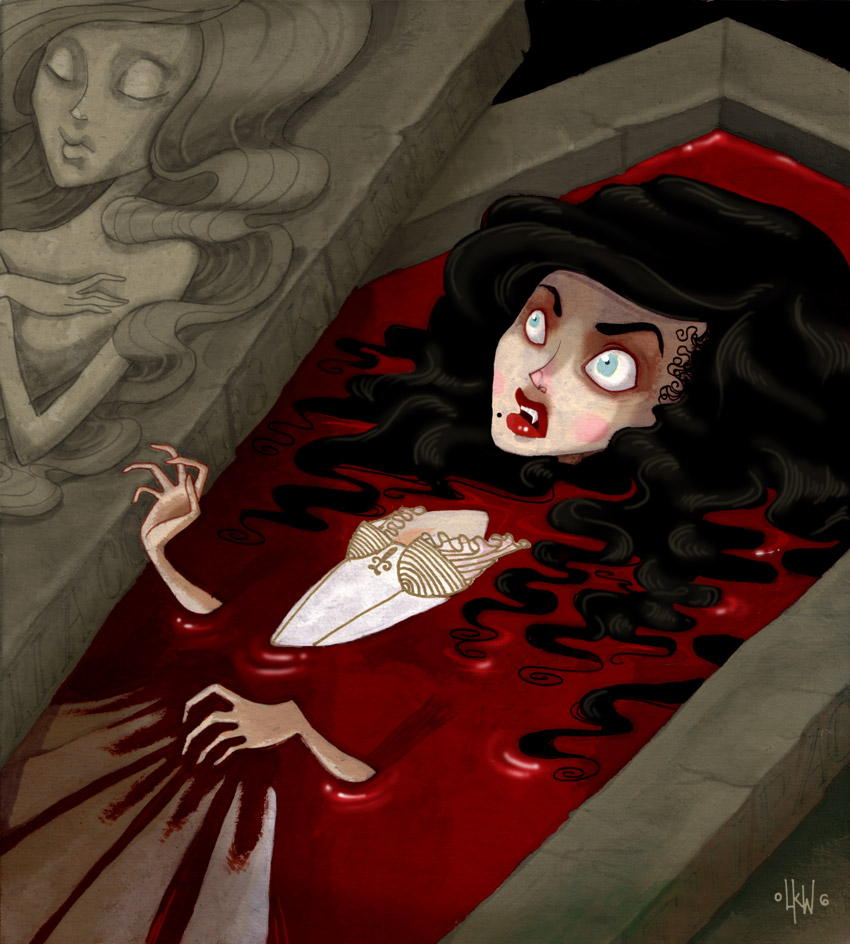
Sheridan Le Fanu’s “Carmilla” stands as one of the first vampiric fictions ever written. This, coupled with the fact that the vampire in question is a female who expresses a “romantic” relationship with the heroine of the narrative, makes “Carmilla” a dynamic story in the Gothic. Aside from the presence of a monstrous creature that haunts and/or terrorizes individuals, “Carmilla” is Gothic in the manner in which it presents and blurs boundaries.

One motif of the Gothic is the exploration of boundaries and/or binaries. More specifically, Gothic fiction presents these binaries and boundaries and blurs them. This can happen in the literal sense (i.e. a specter passing from the earthly realm to the spiritual realm) or in a more metaphorical sense (i.e. a person’s individual role being both good and evil). In Fanu’s “Carmilla”, one aspect of “blurring” can be seen in the protagonist’s reaction to Carmilla. When she is describing how she feels about Carmilla, she states that she “experienced a strange tumultuous excitement that was pleasurable…mingled with a vague sense of fear and disgust” and that she “was conscious of a love growing into adoration, and also of abhorrence” (264). The emotions that she is experiencing act as a juxtaposition, while also functioning as convergence.
She is both drawn to and repulsed by Carmilla. Her emotions can be seen as boundaries blurring and likewise can the source of these emotions be seen in a similar fashion. It isn’t immediately clear whether or not she is drawn to Carmilla because of her vampiric abilities/charm or because she is sexually attracted to her as a woman. Assuming that she is attracted to Carmilla as a woman, is she, then, repulsed by Carmilla herself or her feelings for Carmilla. These indistinct elements are popular characteristics of the Gothic form and is one way in which Fanu brings “Carmilla” into the Gothic and beyond.
 Stuff & Things with Toria