
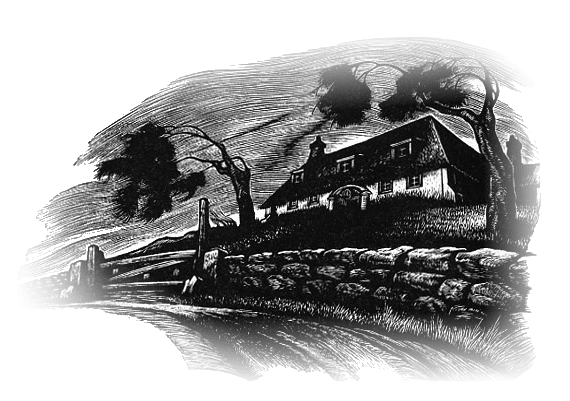

In Emily Bronte’s Wuthering Heights, the character of Lockwood plays a seemingly minor role. Lockwood is a tenant of Thrushcross Grange, the home across from Wuthering Heights. Mr. Lockwood becomes sick one evening, and, in order to entertain him, his housemaid, Nelly, recounts the history of the two houses and the landlord, Heathcliff. In this way, Lockwood’s story acts as the frame for the main narrative, while Lockwood himself functions as a secondary narrator. The story of Wuthering Heights is mostly a retelling of a secondary agent’s account of past events. Lockwood is a device used to present the story to readers; however, he is also representative of a reader in that situation. The area of Wuthering Heights and Thrushcross Grange is very isolated and as such, residents in that area are already aware of its history. Lockwood is a curious and clueless outsider. He asks questions about and forms opinions of the main characters in much the same fashion that a new reader might.
Lockwood is representative of a reader; however, he also functions as an example of basis in a narrative. The story of Wuthering Heights has two main narrators: Nelly Dean – a servant of the homes since childhood – and Lockwood. As most of the narrative is given through Lockwood from a very unbiased Nelly, it can be assumed that the descriptions being given may not be a hundred present accurate.
Before he begins recounting Nelly’s retelling, Lockwood gives his first impressions of Heathcliff and the residents of the Heights: “A capital fellow! He little imagined how my heart warmed towards him when I beheld his black eyes withdraw so suspiciously under their brows…I know, by instinct, his reserve springs from an aversion to showy displays of feelings – to manifestations of mutual kindness” (3-5). Even though the descriptors that Lockwood provides would seem to indicate that Heathcliff and the Heights are both foreboding and unpleasant, that is not the impression that they give Lockwood. Lockwood places his own bases on them, behavior he fully admits to doing: “I bestow my own attributes over-liberally on him” (6). As the narrators of Wuthering Heights very openly admit that basis plays a role in the story, they both provide two different examinations of the theme; Nelly, as a lifelong agent, and Lockwood, as a short-term outsider.
 Stuff & Things with Toria